Tuesday, March 4, 2008

Project 1c Images

So the transition from Project 1b to Project 1c the viewer now gets a chance to see through the construct to the opposite side. by taking away the strip that connected both ends, the construct is easier understood as a series of temporal slats in time. As this study is refined this understanding of representation of time should be more refined. Through the overlapping of wire-frame and solid model one starts to experience the temporal construct as a still image and is able to then contrast that with the animation . Between the two forms of representation hopefully two different understandings of the construct articulated.


Why Tectonics is Square & Topology is Groovy

To become familiar with Greg Lynn’s usage of the word “blobbiness” or “blob”, Lynn looks at defining blobs in three ways. First, in the context of science-fiction horror films, where the blob takes on a form that is all surface and not flat or pictorial. Second, in the realm of philosophy, where the blob is defined as a viscous composite that is fluid like, and easily formed and/or deformed. Finally, how the blobbiness is justified in contemporary construction techniques.

Ok, well my understanding in relating the architectural concept of “blob” to the usage of blobs in films is to try and grasp the underlying concepts that relate to the formalistic notions of what a “blob” is. Easily put, from the 1988 film “The Blob”, we understand the blob to be all surface, not flat or pictorial in anyway. Further defining the blobbiness as a gelatinous surface, having no regular shape. By this description one starts to understand what a “blob” is, and therefore it becomes easily understood how to start thinking about the blob in an architectural sense.


Screen shot from "The Blob" 1988


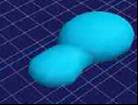
The “blob” in theory: is stated as being “quasi solid” a composite or amalgamated form that is understood to be neither multiple or singular. A form that acts like in many ways that of singularity, while composing itself to any one simple organization or organism. This simple word “BLOB” holds many underlying concepts that result in a freely complex, non-formal geometry. Since these concepts were hard to understand, Lynn introduces the word “isomorphic polysurfaces” which relates to forms that are conceptualized off the Cartesian grid (or irregular blobby shapes). An example of both types of architectural forms is seen below (you figure out which one is which).


As for the “blob” in construction: Lynn in this part of the essay finds some beef with the tectonic practitioner, and their way of looking at man as always structuring himself as standing upright, and therefore buildings should as well. Lynn feels that within structure there are many more layers of complexity then the mere vertical loads of gravity that causes building loads down perpendicular to the ground. He states that we must be looking at interacting with not only vertical and horizontal loads, but with the multiple loads in between, which could become one parameter or many dictating the massing of the buildings form and/or envelop. Moving pass the “upright” Cartesian approach Lynn starts to investigate topological surface organizations, along with isomorphic architecture, as a exploration of the human body and the single cell. Some built architectural examples of these concepts are the works of Shoei Yoh, with his undulating roof surfaces that are created with minor variation in everyone of the structural members. With this slight difference in all members, construction and fabrication would be causes for concern. But with the use of new and innovated techniques in digital fabrication, a combination of prefabricated and on-site assembly moved the construction phase of the projects through to completion.
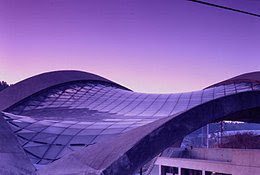


Shoei Yoh, Glass station, Kumamoto, 1993

By creating this type of roof surface, the building program along with the structure would not be compromised by a rather plain and idealized Cartesian like module.

Monday, March 3, 2008

Project 1c (1st attempt)

Well, here I tried to confine this iteration to the representation of frame, and the organizing factors which create the modules of this composition. To try and represent the sectional qualities of the "compositional displacement". I first took away the linear strip that confined the two sides of the construct to unveil the space in between each of the surfaces, in hopes this would give the animation more depth, and stronger spacial qualities. Also by giving the composition a transparency, this hopefully would add to the factor of "time", because as the viewer visualizes one surface at the present point in time, he/she is able to look back and reflect at where the animation was at an early point and time. One could also argue the fact that the viewer is able to catch a glimpse of the future, being able to visualize in a transparent form, of whats to be framed later in the animation. Since this is a first iteration, I will further explore the past animations and develop them, hopefully adding to the re-presenting qualities of the construct, in terms expressed during classes, in readings, and on the blogs.


Tuesday, February 26, 2008

Lines | Linearity

The two articles, Architectural Representation and the Perspective Hinge by Alberto Perez-Gomez and Louse Pelletier, and Lines and Linearity: Problems in Architectural Theory by Catherine Ingraham, found in a collection of essays entitled Drawing | Building | Text by Andrea Kahn (editor) bring to conversation the concepts of seeing and visualization. Starting with the concepts of the line and linearity, Ingrahm theorizes that what gives architecture form in the simplest context is “line”. With that being said, Ingraham states, “ as a subject, the line must be outlined – given a shape or character – and it is precisely at the moment when the line takes a shape that it eludes our grasp”(p.5) I believe that this statement looks at how form seems to take shape, and just at the moment where line defines form that, we no longer understand line but the form that is made up of many different line segments. I guess to try and communicate this a little better I will refer to one of Barnett Newman’s pieces of work entitled Concord.


Barnett Newmann, Concord 1949

Know for his abstraction of the fundamental concept of line Barnett takes his limited palette of color and creates a highly layers yet simple composition of diluted green and yellow washed paints. What we see are the thick spatial fields that are demarked by color, the edges are the relationships to greater composition. Each spatial field’s edge is defined by a line, but is lost in the composition as a whole. These fundamental concepts are followed throughout his works. One more example is part of a series entitled Station, the reason why I bring this to attention is because here Barnett plays with achromatic colors (black & white) which represents a composition built clearly by the line showing the space in between.


Barnett Newmann, Thirteenth Station 1965-66

Animation (project1b 1st attempt)

So clearly this animation was a little more trouble then first expected. For a first iteration not too bad. So here the viewer gets a chance to look and experience this temporal construct in a 3 dimensional virtual world. Basically now by adding animation to the project, we enter another design aspect of the project ( it is like adding another variable to the equation, or so it seems to me, adding another layer to the project ). Looking at animation as a new variable hopefully will add a complexity to the study, with hopes that the study itself does not become complicated to understand, rather easier and in the end more rewarding. See how this is the first attempt, the next few iterations should presumable build upon this animation, and clarify what these studies are looking to understand. I would like in the next few weeks be able to grasp a firm understanding of the programs used, so that it does not constrain me from trying to communicate my understanding of the projects being studied this semester.


Project 1b (Temporal Images)


For this iteration what I was trying to understand from the 3 dimensional construct was the temporal qualities that was not so apparent in the last model. So in hopes of clarifying the understanding of what a temporal construct are the following images for project 1b. Basically the approach I took in this iteration was trying to map the four point of the body, which then would represent a line, simplifying the body form into one line segment. Each one of the lines correspond to a frame taken from the motion video earlier in this study. I hope for the next iteration to start looking at how from a temporal construct, one would move forward to change and study the spacial aspects of these motions.


Monday, February 11, 2008

Temporal Construct (1st Attempt )


Using the line segments from the diagrams below I was able to translate the two dimensional abstraction of my service/ground-stroke into a three-dimensional diagram of what I could define as a temporal construct. These images I generated, speak to me as more temporal, mainly because one can start to see how the movements that are diagrammed below are those relations to my feet, knees, upper body, and the interaction of time.
This first iteration my body movement was some what confusing at first, trying to relate the curvature of the forms I was making into a relationship with the body movements. But as I played with different types of line and model forms, I believe I was able to get to a point where I could talk about what I did and how. These were the points I was struggling with at the beginning of this part of the project. Where I was not sure what I was generating, or what I was trying to represent. Hopefully now people get a sense of where I am trying to move towards in this investigation.