The two articles,
Architectural Representation and the Perspective Hinge by Alberto Perez-Gomez and Louse Pelletier, and
Lines and Linearity:
Problems in Architectural Theory by Catherine Ingraham, found in a collection of essays entitled
Drawing |
Building |
Text by Andrea Kahn (editor) bring to conversation the concepts of seeing and visualization. Starting with the concepts of the line and linearity, Ingrahm theorizes that what gives architecture form in the simplest context is “line”. With that being said, Ingraham states, “ as a subject, the line must be outlined – given a shape or character – and it is precisely at the moment when the line takes a shape that it eludes our grasp”(p.5) I believe that this statement looks at how form seems to take shape, and just at the moment where line defines form that, we no longer understand line but the form that is made up of many different line segments. I guess to try and communicate this a little better I will refer to one of Barnett Newman’s pieces of work entitled Concord.
 Barnett Newmann, Concord 1949
Know for his abstraction of the fundamental concept of line Barnett takes his limited palette of color and creates a highly layers yet simple composition of diluted green and yellow washed paints. What we see are the thick spatial fields that are demarked by color, the edges are the relationships to greater composition. Each spatial field’s edge is defined by a line, but is lost in the composition as a whole. These fundamental concepts are followed throughout his works. One more example is part of a series entitled Station, the reason why I bring this to attention is because here Barnett plays with achromatic colors (black & white) which represents a composition built clearly by the line showing the space in between.
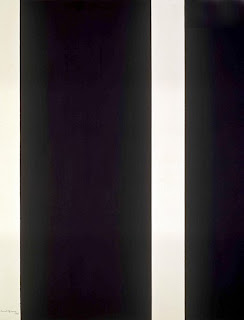 Barnett Newmann, Thirteenth Station 1965-66


